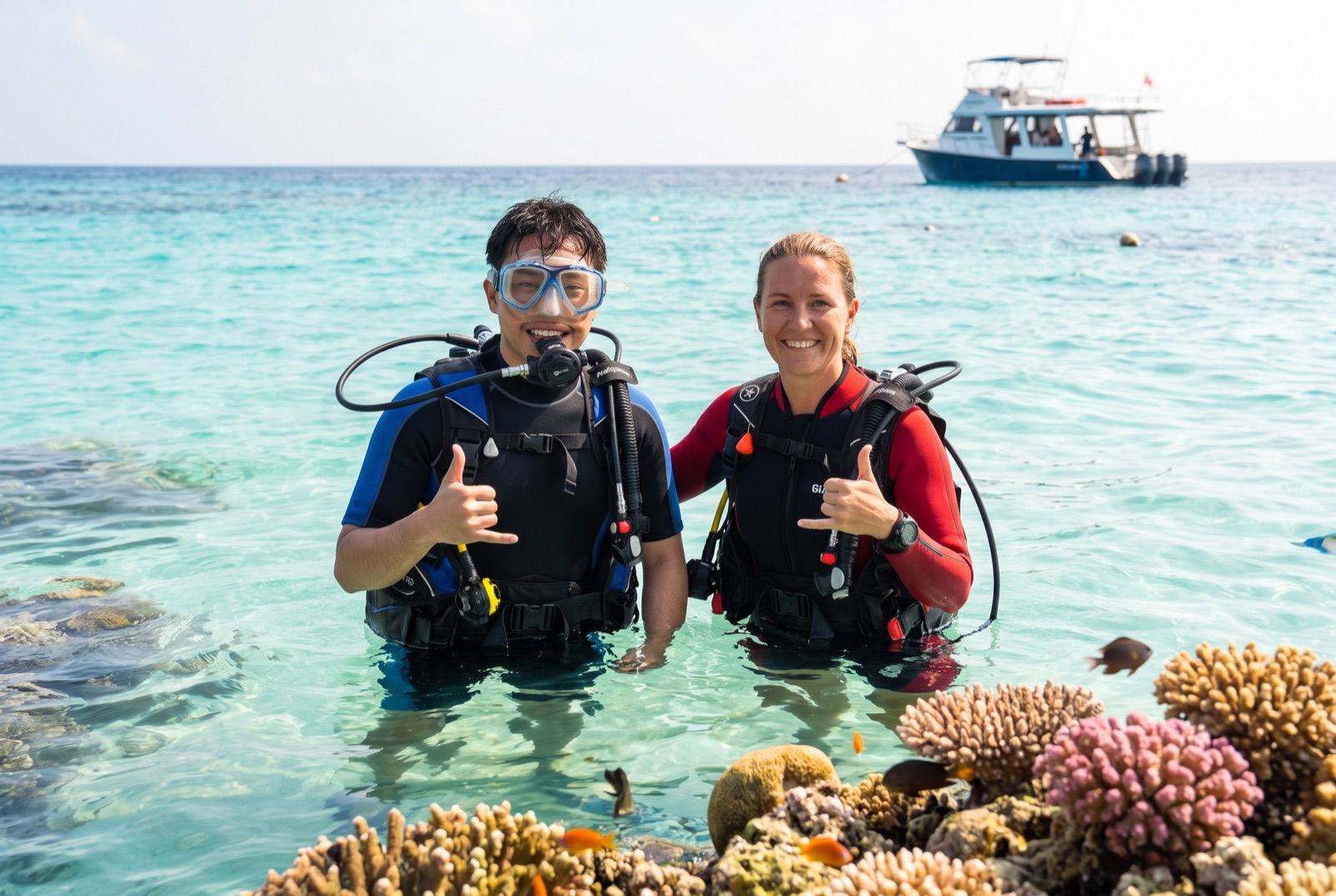
If you have ever surfaced from a snorkel wondering what it would be like to actually breathe underwater, you have two sensible ways to start with PADI: a one-day Discover Scuba Diving experience, or the full Open Water Diver certification course. They sound similar, and both put a regulator in your mouth for the first time, but they are built for very different goals. One is a supervised taster with almost no prerequisites. The other is a proper qualification that lets you dive with a buddy around the world for the rest of your life.
This guide lays out the honest differences so you can pick the right starting point, whether you are a curious hotel guest in Dubai, a resident in Doha, or a family with a scuba-mad 11-year-old.
The short answer
Choose Discover Scuba Diving if you want to try scuba once, are not sure you will love it, can only spare a few hours, or are travelling and want a single memorable dive. It is not a certification — it is a guided introduction.
Choose the Open Water Diver course if you already know you want to dive regularly, want to dive without an instructor holding your hand, and can commit three to four days. It is a globally recognised qualification with no expiry date.
Both are offered by Mermaid Diving Center, a PADI Five Star Dive Resort with teams in Dubai and Lusail, Qatar.
Discover Scuba Diving: the try-dive
Discover Scuba Diving (DSD) is designed for complete beginners who have never breathed from a scuba unit. A PADI Professional gives you a short briefing on the essential safety rules and a few basic skills, then takes you underwater in a closely supervised setting.
Key facts, verified against PADI standards:
- Not a certification. DSD is an experience programme. It does not qualify you to dive independently or rent equipment.
- Depth limit: a maximum of 12 metres on the open-water portion. Confined-water or pool sessions stay shallower, around 6 metres.
- Minimum age: 10 years old. There is no upper age limit, provided you are in good health.
- Non-swimmers welcome. DSD has no formal swim test, which is why nervous or non-swimming guests can take part. You should still be comfortable and relaxed in water.
- Time: a few hours, often a single half-day.
Because your instructor manages your buoyancy and stays close, DSD is genuinely low-pressure. It is the ideal way to find out whether you enjoy the sensation of breathing underwater before spending on a full course.
Open Water Diver: the real certification
The PADI Open Water Diver course is the entry-level certification that most divers around the world hold. Complete it and you receive a card that never expires, recognised at dive centres globally.
Key facts, verified against PADI standards:
- A full certification. Once qualified, you can dive with a buddy — no instructor required — to the limits of your training.
- Depth limit: 18 metres for a certified Open Water Diver.
- Minimum age: 15 for the full adult certification. Children aged 10–14 earn the Junior Open Water Diver rating instead. Those aged 10–11 are limited to 12 metres and must dive with a parent, guardian or PADI Professional; those aged 12–14 may go to 18 metres and must dive with a certified adult.
- Watermanship prerequisites: you must be able to swim 200 metres (or 300 metres using mask, fins and snorkel) with no aids and no time limit, and float or tread water for 10 minutes. Any stroke is fine — this is about comfort and stamina, not speed.
- Time: typically three to four days, split across knowledge development (online or classroom), confined-water skills and four open-water training dives.
The course teaches you to assemble and manage your own kit, control your buoyancy, clear your mask, share air with a buddy and plan a dive. It is more work than DSD, but it is the difference between being a passenger and being a diver.
Side-by-side
| Discover Scuba Diving | Open Water Diver | |
|---|---|---|
| Certification? | No | Yes, never expires |
| Max depth | 12 m | 18 m |
| Minimum age | 10 | 15 (Junior 10–14) |
| Swim test | None | 200 m swim + 10 min float |
| Duration | A few hours | 3–4 days |
| Dive independently after? | No | Yes, with a buddy |
Which should you start with?
Think about three things: commitment, confidence and time.
If you are unsure whether diving is for you, start with DSD. Many people do their try-dive on holiday, love it, and go home to begin their Open Water course. The good news is that a completed Discover Scuba Diving experience can count toward your Open Water certification if you tell your instructor in advance and continue within 12 months — so nothing is wasted.
If you already know you want to dive regularly and you meet the swim requirements, go straight to Open Water Diver. You will usually save money versus doing both separately, and you finish with a qualification rather than a memory.
For families, DSD is often the sensible first step for younger children before they commit to the Junior Open Water course.
Diving conditions in the Arabian Gulf
Both courses in Dubai and Qatar take place in genuinely beginner-friendly water. Sea temperatures in the Gulf are among the warmest of any diving destination: off Dubai the water sits around 22°C at its coolest in January and February and rises to roughly 33°C from July to September. Qatar's waters are similar, ranging from the low 20s in winter to the low-to-mid 30s in high summer — warm enough that a thin wetsuit or even a rash guard is often plenty.
Visibility varies with wind, current and season rather than being fixed; in Qatar the clearest, calmest conditions tend to fall between October and May. What you might see is a genuine draw: turtles, Arabian angelfish, groupers, batfish, barracuda, sergeant majors and rays are all commonly recorded in Gulf waters, along with the occasional parrotfish or reef shark. Off Qatar's coast, one of the world's largest seasonal gatherings of whale sharks appears roughly April to September — though that is an experienced-diver and snorkel spectacle far offshore, not a beginner course dive.
Where the pathway leads
The beauty of starting with Open Water Diver is that it is the first rung of a clear ladder:
- Advanced Open Water Diver: extends your limit to 30 metres and introduces navigation, deep and other adventure dives. Open to certified Open Water Divers aged 15+ (Junior 12–14).
- Rescue Diver: a demanding but rewarding course that teaches you to prevent and manage dive emergencies. It requires Advanced Open Water plus current Emergency First Response (CPR and first aid) training.
- Divemaster: the first professional rating. It requires Rescue Diver certification, current first-aid training, at least 40 logged dives to begin (60 to certify), a medical clearance and a minimum age of 18.
Whichever door you choose first, the same team can take you all the way from your first breath underwater to leading dives yourself.
Ready to decide?
If you are still unsure which course fits your goals, health or schedule, the most useful next step is a quick conversation. Browse the full range on the courses page, or get in touch with the Dubai or Qatar team to talk through your experience level, any medical questions and the best time of year for your trip.