If you are learning to dive in Dubai or Qatar, one question comes up before almost any other: what will I actually see down there? It is a fair thing to ask. The Arabian Gulf and the Gulf of Oman are not the Maldives or the Red Sea, and honest expectation-setting makes for a far better first dive than a highlight reel ever could. The good news is that these waters are quietly full of life. The UAE's seas are home to hundreds of fish species, and once you know what to look for, an ordinary reef dive off Fujairah or a boat dive from the Palm becomes a scavenger hunt with a very satisfying species list.
This guide walks through the marine life you can realistically encounter, framed for identification and for setting expectations rather than promising an encounter with every creature. Nature does not read schedules.
Two very different seas
The UAE and Qatar sit between two connected but distinct bodies of water, and the difference shapes what you see.
The Arabian (Persian) Gulf, on the west coast where Dubai and Qatar sit, is shallow, semi-enclosed and hot. Summer surface temperatures climb to around 33–34°C, and winter lows near Dubai reach roughly 22°C in January. Marine life here is remarkably tough, having adapted to some of the most extreme sea temperatures and salinity levels on Earth. The corals and fish that thrive in this environment are hardy specialists.
The Gulf of Oman, on the east coast around Fujairah, is cooler, deeper and more oxygenated. This is the UAE's unofficial diving capital, with rocky reefs, coral gardens and wrecks. Visibility and marine density are generally better here, which is why most guided reef diving and the whale-shark window centre on this coast.
If you are still choosing when and where to dive, our companion pieces on dive sites and seasonal conditions go deeper on the logistics.
The reliable residents
These are the animals you have a genuine chance of seeing on a typical dive, roughly in order of how often they turn up.
Sea turtles
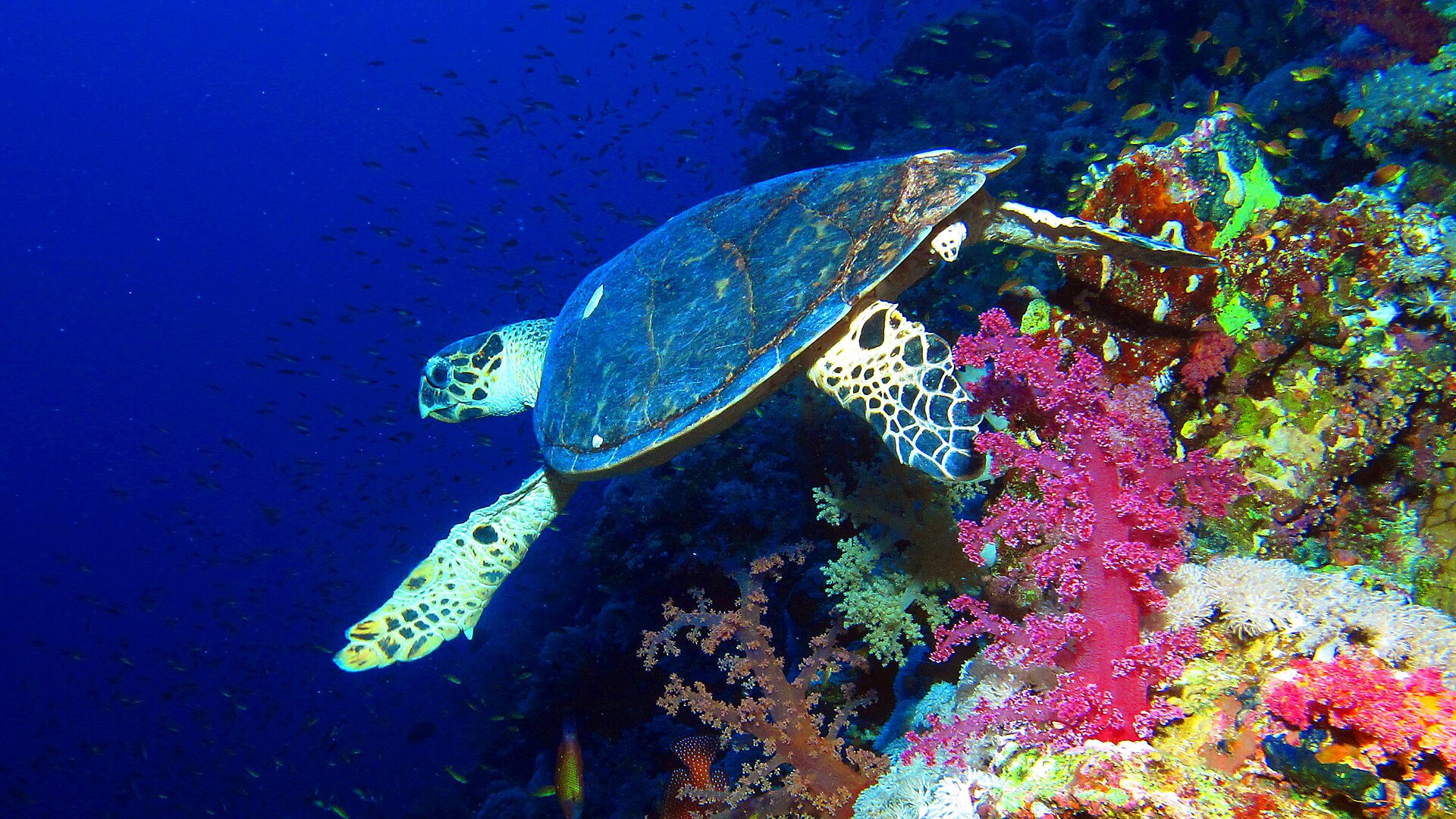
Turtles are the headline sighting for most new divers, and they are genuinely common. Green turtles are the species you are most likely to meet, often grazing on seagrass or resting under ledges. The hawksbill, identifiable by its narrow, pointed beak and overlapping shell scutes, is the main nesting turtle on the UAE's Gulf coast and is listed as Critically Endangered by the IUCN, so an encounter is a privilege. Give both plenty of space and never chase them or block their path to the surface.
Rays
The east coast in particular delivers rays. Look for spotted eagle rays cruising in mid-water, cownose rays, the blotched fantail (marble) ray resting on sand, and various stingrays half-buried near the reef. They are shy rather than dangerous; keep a respectful distance and admire the flight.
Cuttlefish and cephalopods
Cuttlefish are a favourite for a reason. They hover, change colour and texture in real time, and will often hold their ground and study you as much as you study them. Sites such as Martini Rock off Fujairah are well known for them. Octopus also occur but are masters of camouflage, so spotting one is a real win.
Groupers, barracuda and batfish
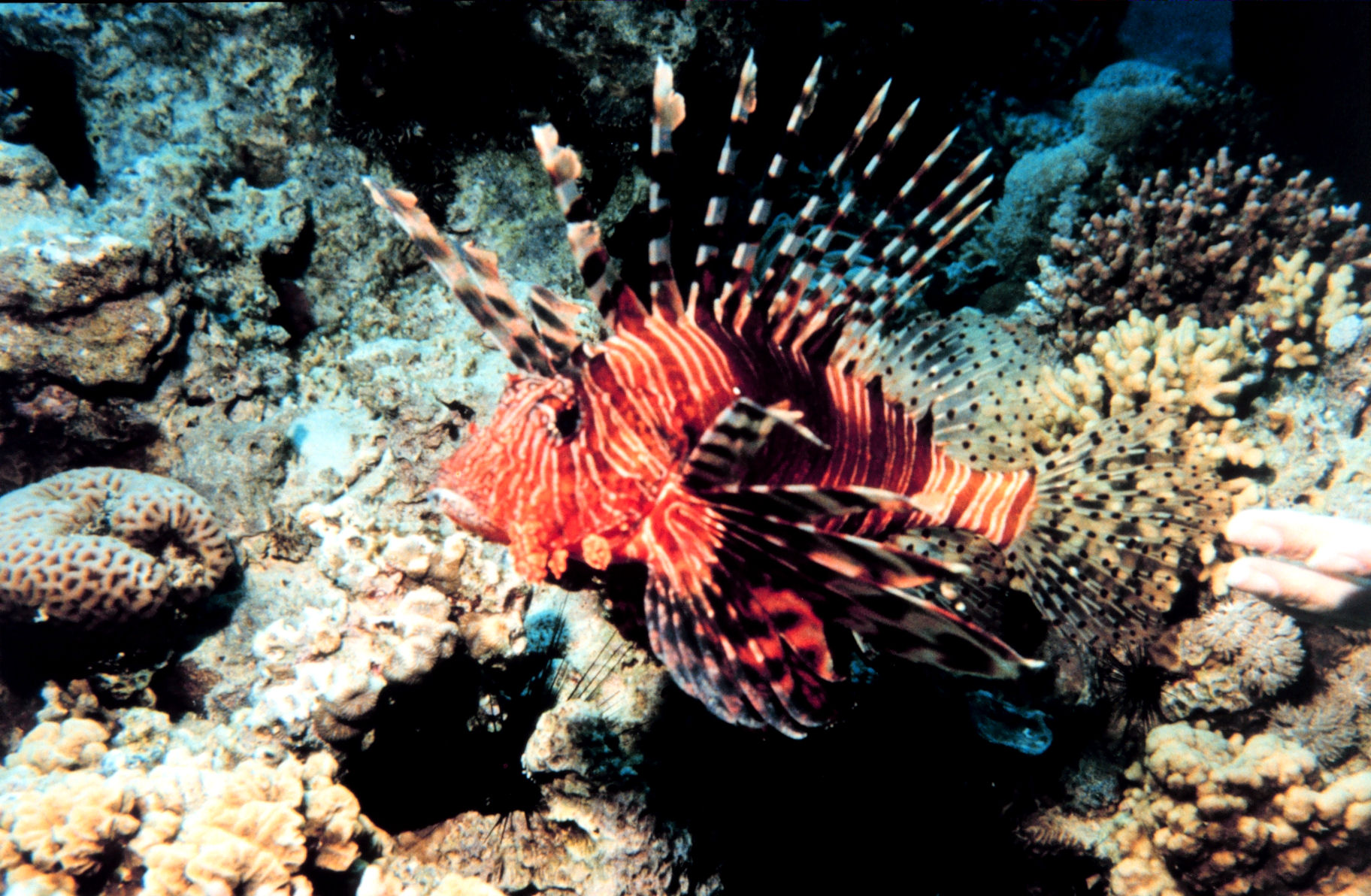
Larger reef fish give a dive its sense of scale. Groupers hold territory around rocks and wrecks. Barracuda patrol deeper water, sometimes in schools, looking more menacing than they are. Batfish, tall and disc-shaped, often drift curiously around wreck structures and are one of the easier "big" fish to photograph.
Moray eels
Peer into cracks and overhangs and you will frequently find a moray eel with its head out, mouth opening and closing. That gaping motion is just how it breathes, not aggression. Keep your hands out of holes and you will never have a problem.
The colour and the small stuff
Arabian angelfish
The Arabian angelfish (Pomacanthus asfur) is one of the region's signature beauties: a dark blue body with a blackish face, a bright yellow crescent band across the flank and a yellow tail. It occurs in the Arabian Gulf and favours sheltered inshore reefs. Spotting one against the blue is a highlight of many dives.
Nudibranchs and macro life
Slow down and the reef opens up. Nudibranchs, tiny sea slugs in startling colours, are prized by macro photographers and reward divers who look closely at rock faces and sponges. You may also find seahorses, scorpionfish and, with a sharp-eyed guide, well-camouflaged frogfish. This slow, close-up looking is a skill in itself, and a good buoyancy foundation makes it possible without kicking up the bottom or bumping the reef.
The whale-shark window
For many divers, the dream is the whale shark — the world's largest fish, a gentle, spotted filter feeder that eats plankton and fish spawn and poses no danger to humans.
Two seasonal patterns matter here.
Off Fujairah and the Gulf of Oman, whale sharks appear seasonally, most often reported from spring into the late-summer months, with encounters building through spring and into summer. Crucially, they are never guaranteed. Anyone promising a certain sighting is overselling it. Treat an encounter as a wonderful bonus, not the point of the trip.
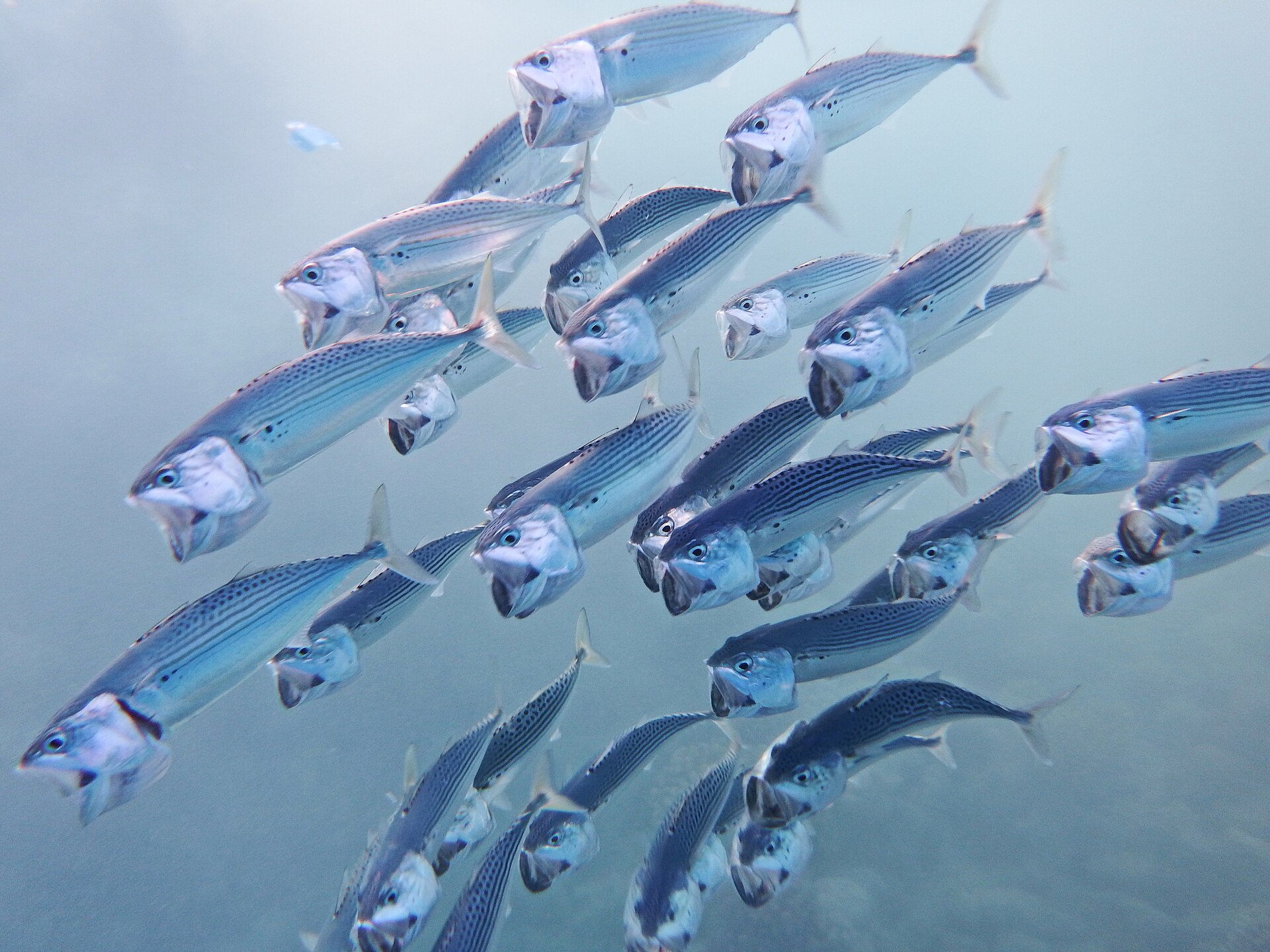
In Qatar, the story is different and remarkable. Each year hundreds of whale sharks aggregate near the Al Shaheen oil field, about 90 km off the northeast coast, from roughly April to September, drawn by mackerel tuna spawn. With more than 600 individuals identified over the years, it is one of the largest known aggregations of whale sharks in the world. Access is regulated and offered as a snorkelling experience rather than scuba, specifically to minimise disturbance.
Whatever the coast, the rules are the same because whale sharks are Endangered and protected in UAE waters. Never touch one — it strips the protective mucus from its skin. Keep a few metres clear of the head and body, stay well away from the powerful tail, enter the water gently, and never block the animal's path. Responsible behaviour is what keeps these encounters possible.
Setting realistic expectations
The single most useful mindset for diving here is patience. Some dives serve up turtles, rays and a cuttlefish in one go; others are quieter, with the reward hidden in the small stuff. Water clarity varies with season, wind and plankton, and the same site can look completely different week to week. A calm, well-briefed diver who moves slowly and looks carefully will always see more than someone racing along.
Building that calm comes down to comfort in the water, which is exactly what proper training gives you. If you are just starting out, a PADI course — from a first Discover Scuba experience through Open Water — is the foundation that turns "what will I see" into "look what I saw." For guided fun dives, seasonal advice or questions about the whale-shark window in Dubai or Qatar, get in touch with the dive team; local knowledge of the day's conditions is worth more than any calendar.
The Gulf may not be the flashiest sea on the planet, but its life is real, resilient and closer than you think. Learn to read it, and every dive becomes a story worth telling.